Artificial Grass Yarn Technology
Advanced Engineering Powered by Artificial Grass Yarn Technology
Advanced Turf Yarn Technology & UV Protection
Turf Yarn Technology is the core of LFL Grass quality. Premium PE & PP yarn with anti‑UV stabilizer, anti‑abrasion formula. Special yarn twisting & shaping technology
reduces fiber fraying, resists flattening under heavy‑use.
Long color retention, high wear resistance for high‑traffic football, padel courts, extend turf service life.


Bionic Simulation Technology
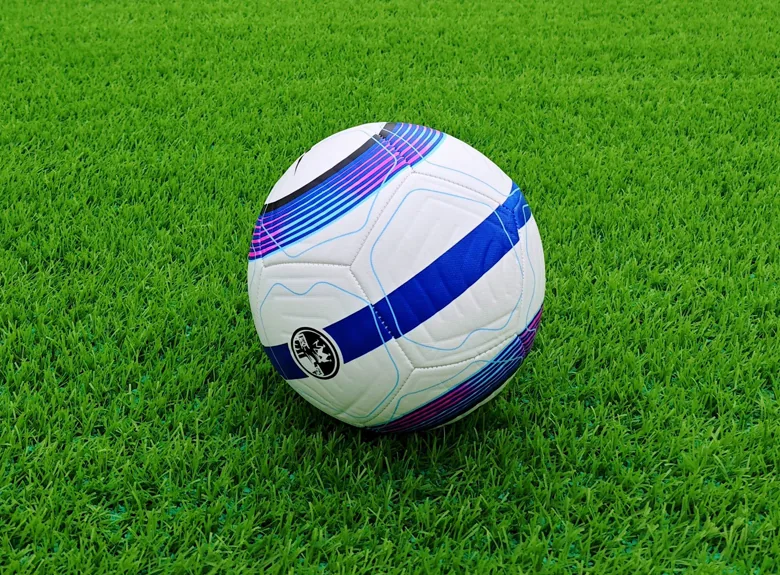
Bionic blade shape mimics natural grass texture and touch. Optimized blade shape improves ball roll performance and offers natural visual appearance. Realistic look & feel, great ball rebound performance for sports fields.
Backing Technology
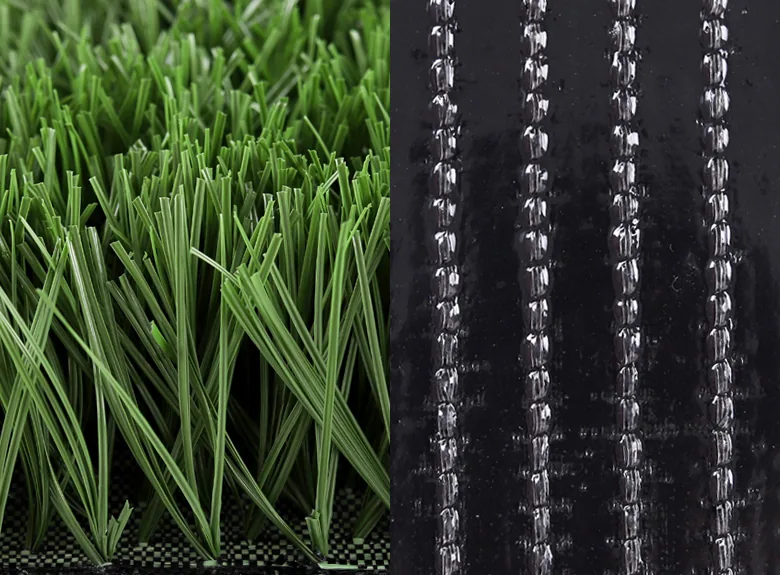
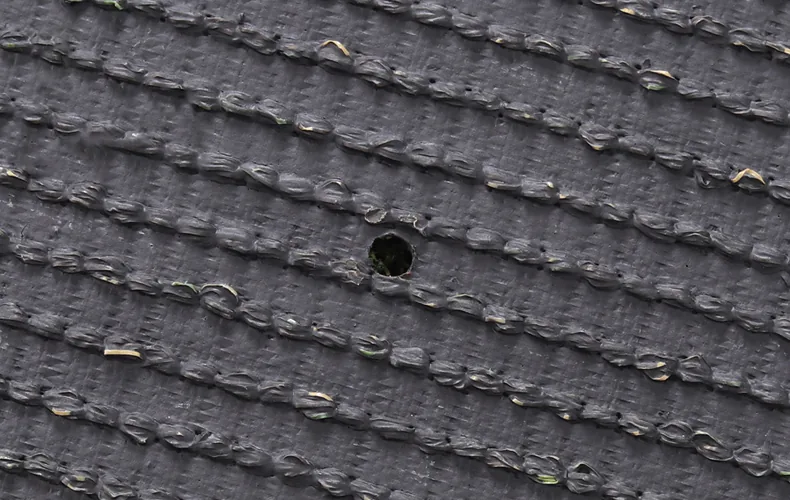
Multi‑layer composite backing, high tensile strength, excellent dimensional stability. Strong bonding between yarn and backing to prevent fiber shedding. Resist deformation, less grass‑pull‑out, adapt to different ground bases for long‑term installation.
Drainage Technology
Premium PE & PP yarn with anti‑UV stabilizer, anti‑abrasion formula. Special yarn twisting & shaping technology
reduces fiber fraying, resists flattening under heavy‑use.
Long color retention, high wear resistance for high‑traffic football, padel courts, extend turf service life.
Safety Performance
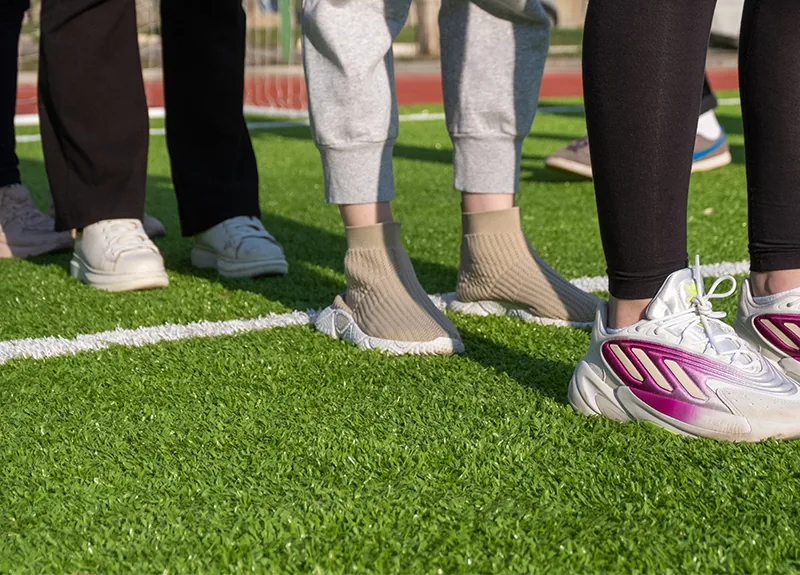
Optimized shock‑absorbing structure, reduce impact injuries during sports. Fire‑retardant option available. Pass safety related lab tests.Lower risk of bruising and fall injuries for athletes, suitable for schools & public projects. See our Yiwu artificial grass showroom for samples.
Environmental-Friendly Technology
Non‑toxic raw materials, heavy‑metal free. Low VOC, recyclable materials. Safe for kids, pets and environment, meets international environmental standards. Learn more about our artificial grass products.
What yarn technology actually means
Every artificial grass surface is only as good as the yarn it is made from. Yarn technology covers the chemistry of the polymer, the shape the fibre is extruded into, how the fibre is twisted and heat-set, how it is stabilised against ultraviolet light, and how it is tufted into the backing. Get those five things right and the surface stays upright, keeps its colour and plays consistently for years. Get them wrong and the pile flattens, the fibres fray and the colour fades within a season or two.
On this page we explain the yarn specifications buyers ask about most, how each one changes performance on the pitch or in the garden, and what to check before you approve a sample. For a full classification of fibre types and how each is used, see our artificial turf yarn types guide.
The three main yarn families
| Monofilament | Single extruded strands, usually shaped (C, S, diamond, V). | Springy, resists matting, sharp definition. Used for football, padel, hockey and premium landscape turf. |
| Fibrillated | Flat tape that splits into micro-fibres when brushed. | Soft, dense appearance, good wear resistance. Common for landscape and multi-use sports turf. |
| Slit film | Simple flat tape, no splitting. | Economical, lighter duty. Suitable for decorative and low-traffic applications. |
Most sports surfaces use monofilament, alone or blended with fibrillated yarn to balance resilience with a natural, dense look. Landscape turf usually reverses that balance.
Why yarn profile matters
The cross-section of a monofilament yarn is not cosmetic. A C-shape yarn traps more air and holds the pile upright under foot traffic. An S-shape or double-S profile adds rigidity, which helps the fibre recover after being pressed down. A diamond profile cuts weight while keeping a springy feel. Narrower, more numerous fibres give a softer surface; wider fibres give a crisper, more upright look.
For sport, the profile also changes how the ball behaves. Football turf is normally specified with a shaped monofilament that keeps the pile standing so ball roll and bounce stay predictable across the pitch. Padel courts use a shorter, denser pile where consistency across the whole court is the priority.
Dtex, tufting density and face weight
Three numbers describe how much yarn is in the carpet: Dtex (the weight of yarn per 10,000 metres), tufting density (stitches per square metre) and face weight (grams of yarn per square metre). They interact. A high-Dtex yarn at low density gives a soft, open surface; a moderate Dtex at high density gives a firm, dense surface that resists flattening.
Face weight is the number that best predicts durability under heavy use, which is why sports specifications focus on it rather than on pile height alone. When you compare quotes from two suppliers, compare Dtex, density and face weight together — and ask what pile height they were measured at.
UV stabilisation and colour retention
Ultraviolet light is what ages artificial grass: it breaks polymer chains, which shows up first as colour fade and later as brittleness. UV stabilisers are masterbatched into the polymer before extrusion, so the protection sits inside the fibre rather than on its surface.
Colour pigments are chosen for lightfastness, and green turf is usually built from several yarn shades so the surface reads as natural rather than flat. A useful claim to look for is an accelerated weathering test result — our yarns are tested to 5,000+ hours of UV exposure. Ask any supplier for the test report, not just the number.
What is UV resistant grass yarn?
UV resistant grass yarn is yarn that has UV stabilisers compounded into the polymer itself, rather than coated on afterwards. That distinction matters: a surface coating wears away as the pile is brushed and walked on, while stabilisers inside the fibre keep working for the life of the turf. Colour pigments are selected for lightfastness at the same time, because a yarn can stay strong and still fade.
When buyers ask us for “UV resistant grass yarn”, the answer we give is a number: our yarns are tested to 5,000+ hours of accelerated UV exposure, and the test report is supplied with the order. If you are specifying turf for a high-UV market — Africa, the Middle East, Australia, southern Europe — ask every supplier for the same figure and the report behind it.
Abrasion resistance and fibrillation control
Abrasion is the second failure mode. Under cleats, racket shoes and constant brushing, fibres can split, fray or shed. Two things control this: the polymer grade and the amount of twist and heat-setting applied after extrusion.
Heat-setting locks the crimp into the fibre so the pile bounces back instead of collapsing. Controlled fibrillation — where a tape splits only into fine, even strands — gives the soft look of natural grass without the shedding that comes from uncontrolled splitting.
The backing is part of the system
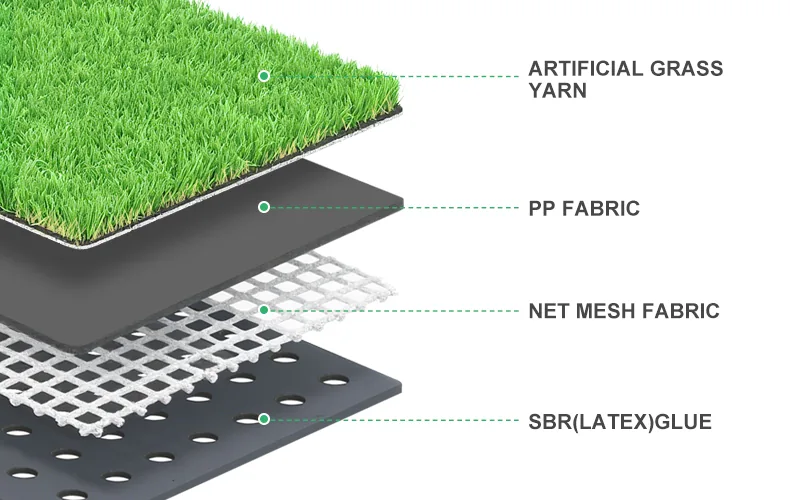
Yarn performance depends on what it is tufted into. A primary backing holds the tufts; a secondary coating locks them in place. PP + PU and PP + net + SBR are the two builds we use most: PU gives dimensional stability and a firm feel, while a net layer adds tear strength and helps drainage.
Perforated backings let water pass through the carpet and into the base, which is essential for outdoor courts and for gardens that see heavy rain.
Matching yarn specification to the application
- Football and multi-sport pitches — shaped monofilament, higher face weight, sand or performance infill, pile typically 40–60 mm.
- Padel and tennis courts — short, dense pile (10–15 mm for padel), C/S-shape yarn and a stable, water-permeable backing.
- Gym and fitness turf — crimped or KDK yarn with high resilience for sleds and functional training, often with no infill.
- Landscape and gardens — fibrillated or soft monofilament in 25–45 mm, chosen for look, softness and UV stability.
How to verify yarn quality before you buy
- Ask for the yarn specification sheet: polymer, Dtex, shape, UV package.
- Ask for accelerated UV and abrasion test reports, not just a claim.
- Request a sample and press it — the pile should spring back rather than stay flat.
- Check the backing: look for even coating, no loose tufts, and perforations if drainage matters.
- Confirm the face weight and density at the pile height you are actually ordering.
Frequently asked questions
What is the best yarn for artificial grass?
There is no single best yarn — it depends on the application. Shaped monofilament suits sports surfaces that need resilience; fibrillated yarn suits landscape turf that needs a dense, soft look. The right answer combines the yarn family, Dtex, density and backing.
What does Dtex mean in artificial grass?
Dtex is the weight in grams of 10,000 metres of yarn. A higher Dtex means a heavier, thicker fibre, which usually gives more resilience and durability when tufting density is held constant.
How long does UV stabilisation last?
Quality yarns are tested to thousands of hours of accelerated UV exposure, which corresponds to many years of outdoor use. Actual service life depends on climate, altitude and usage intensity.
Does heat-set yarn really make a difference?
Yes. Heat-setting fixes the crimp, so the pile stands up and recovers after traffic. It is one of the clearest differences between a budget carpet and a specification-grade one.
What makes a yarn UV resistant?
The stabiliser package blended into the polymer before extrusion, plus lightfast pigments. A UV resistant yarn keeps its colour and tensile strength under prolonged sun exposure; the standard way to compare suppliers is the number of accelerated weathering hours tested, supported by a test report.
Can yarn be customised for OEM projects?
Yes. We produce custom Dtex, yarn shape, colour, pile height and backing for private-label and OEM programmes — send us the target specification and we will match it.
LFL Grass yarn, factory direct
We extrude, twist, heat-set and tuft our own yarn, which is why we can hold a specification instead of approximating it. Every order is produced against the agreed Dtex, density, face weight and colour, and we supply test documentation with production. Tell us your application — football, padel, gym, landscape or a mixed catalogue — and we will propose a yarn and backing combination, with a sample for approval before production.
Buying yarn: how to choose an artificial grass yarn supplier
Most buyers reach this page after a bad experience somewhere else: a quoted Dtex that arrives lighter, a colour that shifts between batches, or a yarn that turns brittle after two summers in the sun. Those problems are almost never caused by the polymer itself — they come from buying yarn from someone who does not control the line that makes it. Here is what separates a real yarn manufacturer from a reseller, and the questions worth asking before you place an order.
Ask who actually extrudes the yarn
A trading company buys yarn or finished carpet on the spot market and sells it on. That works until the spot market changes, and then the specification you approved is the first thing to move. A manufacturer extrudes, twists, heat-sets, tufts and coats in its own plant, which is the only way to guarantee that the second order matches the first. We do all of it under one roof, which is why we can hold a specification instead of approximating it.
Ask for the specification in writing, per batch
You should be able to see Dtex, yarn shape, polymer, UV package, colour reference and the tolerance band before you pay a deposit. If a supplier quotes a wide range for everything and a single fixed price, expect to receive whatever sits at the bottom of that range. Ask what the tolerance is on Dtex and on colour, and ask whether it is written into the order.
Ask for the UV and abrasion test reports
Ultraviolet light is what ages artificial grass, and colour fade is the first symptom. Our yarns are tested to 5,000+ hours of accelerated UV exposure. Ask any supplier for the actual test report — not the number in the brochure. The same applies to abrasion and tuft withdrawal if the yarn is going into a sports surface.
Ask what happens on the second and third order
This is the question that separates suppliers most cleanly. Colour matching across batches, holding a fixed density, keeping the same backing build — these are manufacturing commitments, not sales promises. If a supplier cannot tell you how they hold a colour reference six months later, assume they cannot.
Ask about minimum order and colour
Stock colours ship faster and in smaller quantities, which matters if you are testing a market or filling a gap in a catalogue. Custom shades and custom Dtex need a minimum production run. Ask which colours are stock, what the minimum is for a custom shade, and how long a run takes — the answers are usually the difference between a workable margin and a stranded order.
LFL Grass as your yarn supplier
LFL Grass is an artificial grass yarn manufacturer and exporter based in China, supplying monofilament turf yarn, fibrillated yarn and PE / PP uv resistant turf yarn to turf producers, OEM programmes and private-label brands. We supply in stock colours and custom shades, with test documentation issued against production.
If you are comparing artificial grass yarn suppliers, send us the specification you need — Dtex, yarn shape, colour reference and quantity — and we will quote against it and send a physical sample of the exact build before you commit. That route is faster than comparing brochures.