
Short answer: artificial moss is synthetic greenery that mimics the texture and colour of natural moss on walls, planters, staircases and indoor displays. It needs no water, light or trimming, keeps its colour in both sun and shade, and is supplied as mats, panels or sheets that are cut and glued into place.
What artificial moss is made of
Artificial moss is a decorative green material built from polyethylene or polypropylene fibres attached to a flexible backing. The fibres are short, fine and irregular on purpose – the point is to reproduce a soft, damp-looking surface without the maintenance that real moss demands. It is sold as mats (a carpet-like roll), as panels for wall systems, and as preserved natural moss for spaces where no sunlight reaches and the budget allows.
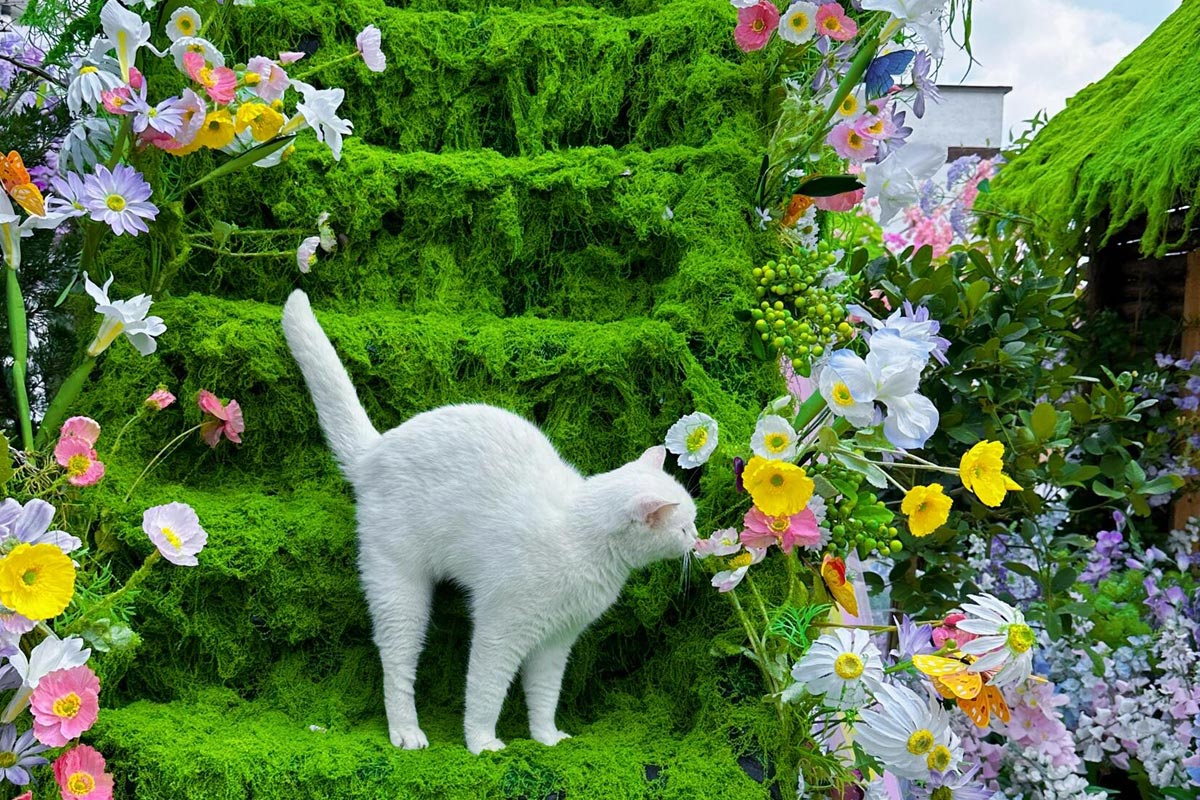
Artificial moss versus real moss
| Factor | Artificial moss | Real moss |
|---|---|---|
| Watering | None | Constant humidity required |
| Light | Works in dim corridors and basements | Needs the right light and airflow |
| Lifespan | Stable for years with dusting | Dies if the conditions are wrong |
| Appearance | Uniform, always green | Natural variation, seasonal change |
| Best for | Walls, retail, events, balconies | Gardens and terrariums with care |
Where artificial moss works best
- Feature walls and living-wall frames, where real plants would need irrigation and drainage.
- Staircases and planters in courtyards and entrance areas.
- Retail and hospitality displays, including window sets and product backdrops.
- Event and exhibition stands, where a green surface has to be installed in hours.
- Balconies, terraces and rooftops that get too much sun for moss to survive.
- Interior corners with no daylight, where clients still want a natural green texture.
Choosing the right product for the location
- Outdoor and wet areas: UV-stabilised PE mat with a drainage-friendly backing.
- Indoor walls: lightweight panels that can be cut around sockets, frames and signage.
- High-touch areas: dense mats with fibres that will not shed when people brush past them.
- Fire-sensitive venues: ask the supplier for the flame-retardant documentation of the exact product, not of the category.
Installation and maintenance
- Clean and dry the substrate – board, render, metal frame or planter.
- Measure and cut mats or panels with a fresh blade, leaving a small overlap at the seams.
- Fix with an exterior-grade adhesive or mechanical clips, depending on the surface.
- Blend the seams by hand so the pile direction runs consistently.
- Dust or vacuum the moss monthly; rinse outdoor installations occasionally and let them dry.
What artificial moss costs
Price per square metre depends on fibre density, backing and whether the product is purely synthetic or a preserved natural material. The installed cost depends more on the fixing method than on the moss itself: a flat planter is quick, while a curved feature wall needs cutting, adhesive and careful seam blending. For large landscaping schemes, artificial moss is usually specified alongside other synthetic greenery such as landscape artificial grass and plant-wall elements, so that one supplier handles the whole green package.
Frequently asked questions about artificial moss
Does artificial moss fade in sunlight?
UV-stabilised synthetic moss holds its colour outdoors for years. Unstabilised product fades within a season or two, so always confirm the fibre is UV-treated if the installation faces direct sun.
Can artificial moss be used in a bathroom or spa?
Yes, in well-ventilated rooms with a mould-resistant fixing. Humidity itself is not the problem; trapped water behind the backing is, so the substrate must dry between uses. Indoor air quality is worth planning for in enclosed spaces – the EPA indoor air quality guidance covers ventilation basics.
Is it safe for pets and children?
Synthetic moss made from PE or PP fibre with no loose infill is safe for occasional contact. Check that seams are glued down so nothing can be pulled loose, and keep preserved natural moss out of reach if it has been treated.
How do you clean artificial moss?
Vacuum with a brush attachment or shake mats out. For outdoor installations, rinse with a hose and let the material dry fully before reinstalling; avoid detergents that leave residue in the fibres.
Where to buy artificial moss and green wall materials
LFL Grass supplies artificial greenery from Yiwu, China, for landscape projects, retail displays and interior installations, with custom cut sizes, colour matching and mixed orders alongside landscape turf and plant-wall elements. Minimum order quantity on greenery is 500 m2 for bulk programmes, and samples can be arranged for approval before production. Browse the product range, review the yarn technology guide to understand fibre quality, or send your drawings and quantities to dx@lflgrass.com.
