
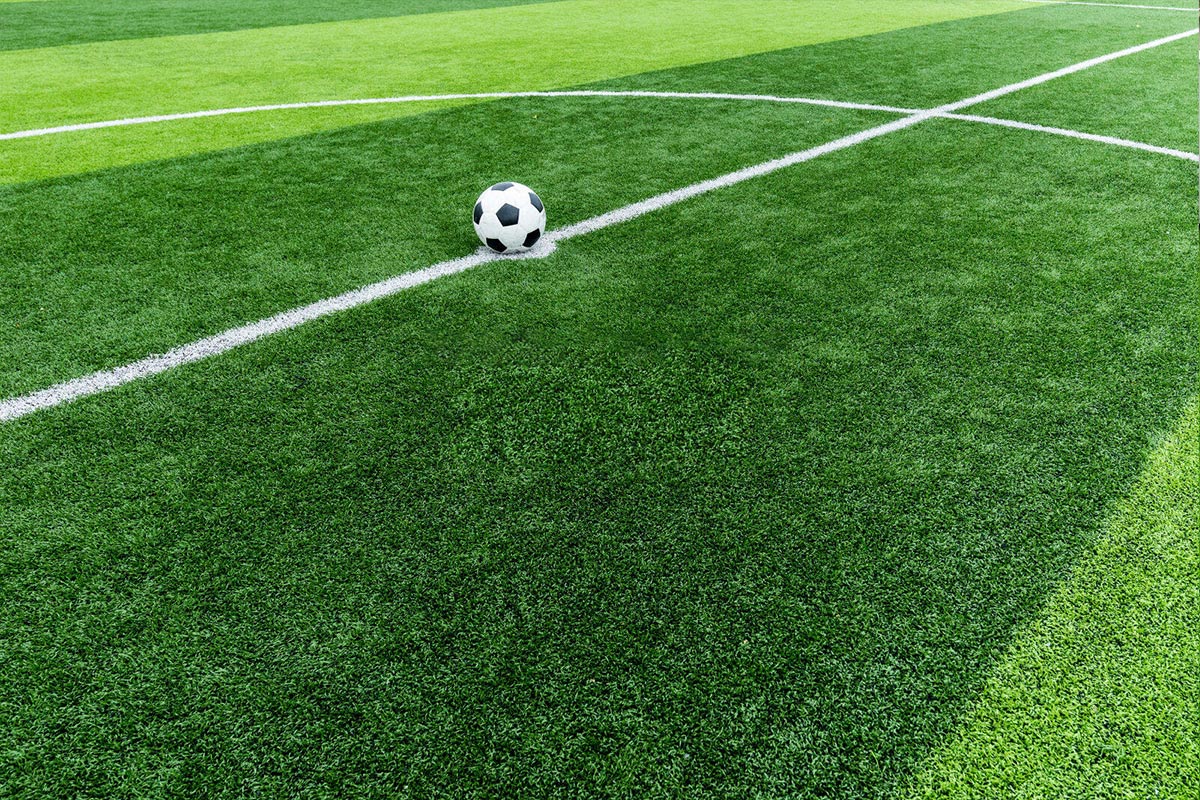
Short answer: football artificial grass is a synthetic pitch system built as layers – compacted base, optional shock pad, synthetic turf and performance infill. Pile heights run from 40 mm for training and multi-use fields to 60 mm for full-size competition surfaces, and the infill depth controls ball roll, shock absorption and stud traction.
What football artificial grass is
Football artificial grass, also called soccer turf or a synthetic pitch, is a specialist sports surface rather than long-pile landscape turf. The fibres are thicker and more resilient, the stitch rate is denser, and the surface is normally filled with sand or rubber granules so players get consistent traction and the ball behaves predictably. Without the right infill, a synthetic field plays fast and unforgiving.
How a football artificial grass pitch is built
- Sub-base. Excavation, geotextile and 150-300 mm of compacted aggregate, with falls for drainage.
- Drainage. Perimeter channels or a herringbone pipe system, sized for local rainfall.
- Shock pad (optional). Elastic layer that reduces impact and lets the field meet performance targets.
- Turf carpet. 40-60 mm fibre, tufted into a dimensionally stable backing.
- Infill. Sand, rubber or organic granules brushed into the pile to the specified depth.
- Line marking. Inlaid or painted lines, cut to the exact pitch layout.
Pile height, yarn and infill selection
| Playing level | Pile height | Infill approach | Notes |
|---|---|---|---|
| School and community multi-use | 40-45 mm | Sand-dressed | Durable, low maintenance, firm surface |
| Training and academy pitches | 50-55 mm | Sand and rubber, 15-25 mm | Balanced speed and shock absorption |
| Competition and stadium fields | 55-60 mm | Performance infill to tested depth | Built to meet recognised pitch standards |
| Indoor futsal and gym turf | 30-40 mm | None or light sand | Low friction, easy to clean, no infill migration |
Yarn profile matters as much as pile height. Monofilament fibres with a spine resist bending and keep the pitch looking upright season after season; that is the specification behind our 50 mm FIFA-certified football turf. Where the field also hosts community sport, a slightly shorter, denser carpet such as the 50 mm multi-use pitch turf wears more evenly.
Standards, testing and safety
Competition football pitches are evaluated on ball roll, vertical rebound, shock absorption and rotational resistance. The FIFA quality programmes for football turf define these tests and the pitch performance categories that follow from them – the FIFA football technology programme publishes the current framework. In practice this means buyers should ask a supplier for test reports on the specific system – turf, pad and infill together – rather than for a fibre data sheet alone, because performance is a property of the assembly.
Maintenance across a playing season
- Weekly: drag-brush the pitch to lift flattened fibre and redistribute infill.
- Monthly: check infill depth in goal areas, the centre circle and high-traffic zones; top up where it has migrated.
- After storms: clear drains and remove debris before the next session.
- Quarterly: inspect seams, line inlays and edge fixing; repair before small lifts become trip hazards.
- Annually: deep clean, re-test where a certification is being maintained, and plan for infill replacement.
Does an artificial pitch get too hot to play on?
Surface temperature can rise well above air temperature in strong sun, so summer sessions are often scheduled in the morning or evening. Irrigation, lighter infill and shade structures all reduce heat build-up, and FIFA guidance covers cooling and player welfare alongside the technical requirements.
Frequently asked questions
How long does a football artificial grass pitch last?
Most community and school fields are planned on an eight to twelve year cycle with annual maintenance; heavy-use stadium surfaces are often replaced sooner. Fibre quality, infill management and how many hours per week the pitch is played on drive that number.
Is the rubber infill safe?
Modern systems use washed, tested infill and closed-loop cleaning to keep the surface free of dust and debris. Buyers should ask for material documentation and check local regulations, and plan end-of-life disposal early – the EPA recycling guidance is a reasonable starting point for what can be recovered.
Can a football pitch be used for other sports?
Yes, with the right specification. A 40-50 mm sand-dressed field handles football, rugby training, athletics warm-ups and community events without the deep infill that makes a surface too soft for running.
Buying football artificial grass
LFL Grass supplies football and multi-use sports turf from Yiwu, China, in 40-60 mm pile heights with custom line marking, roll widths up to 15 ft and both sand-dressed and rubber-infill specifications. Minimum order quantity is 500 m2 and pitches can ship LCL or by full container. Explore the soccer field grass range, read the yarn technology guide to compare fibre profiles, or send your pitch dimensions, playing hours and standards requirement to dx@lflgrass.com.
Buying football turf for African markets
Football pitches are the single largest use of sports artificial grass in Africa, and the buying pattern there is different from Europe or the Middle East: buyers source in Yiwu, often through an agent, and specify for strong UV, high usage and fast drainage. If you are importing for an African market, our guide to artificial grass for Africa covers the specifications, trade terms and the sample-room route.
