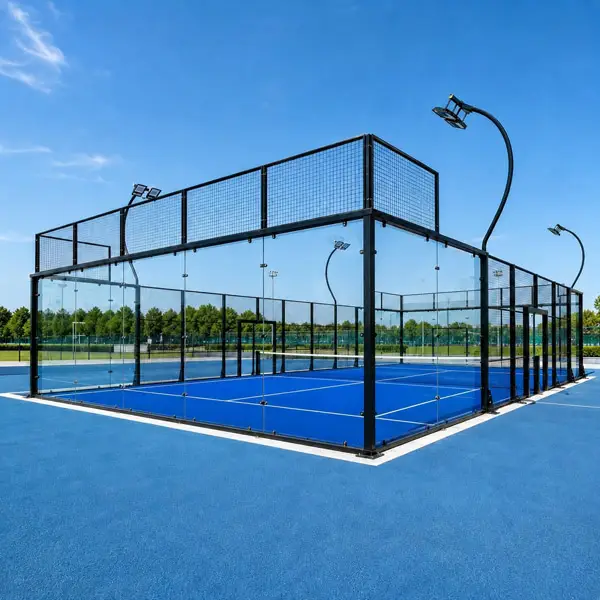
Padel and tennis look like the same kind of project, but they place opposite demands on the turf. A padel court uses a short pile with no infill, relying on a dense fibre structure for consistent ball response and shock absorption. A tennis court uses a sand infill, where the sand layer sets the pace and the feel underfoot. Mixing up the two specifications is the most common way these projects fail.
LFL Grass supplies both lines in this category: a short-pile, no-infill system developed specifically for padel courts, and a sand-filled system for tennis and multi-use courts. This guide sets out both specifications, the certification route, recyclability and drainage design in one place.
Quick Answer: Four Points That Matter Most
If you read only one paragraph, read this one. Padel court turf is typically 10–15 mm pile with no infill — height, density, width and colour are all made to order — and the metrics that matter are low ball bounce deviation and shock absorption. Tennis court turf is normally a sand-filled construction, where the metrics are ball rebound and court pace, and European projects generally require compliance with EN 15330-1. GRS proves recycled content, not recyclability. On drainage, padel turf drains quickly by itself — the real risk sits in the glass wall footings, the frame posts and the outlet design around the court perimeter.
In four points: first, padel and tennis courts need different specifications and one product cannot serve both; second, ask which standard a CE document was issued against and require a Transaction Certificate alongside any GRS claim; third, court and surrounding-area drainage must be routed separately, or the court edge becomes a catchment; fourth, colour, height, density and width are all customisable — blue and purple are standard choices on padel courts, and lighter tones also run cooler.
Further reading: the full padel court package, including glass panels, posts, net, lighting and turf, is set out on our complete padel court solutions page.
Why Padel Is the Court Category to Watch in Europe Right Now
Padel has expanded faster across Europe than any other court category in the past decade. Spain and Portugal are mature markets, while Italy, France, Sweden, the Netherlands, the UK and Germany are in rapid growth. Projects range from clubs and resorts to residential communities, private courtyards and office rooftops, which makes demand highly fragmented.
That fragmentation has a direct sourcing consequence: buyers have little basis for judging turf on experience. A padel court is a standardised size with standardised play, so a wrong surface is felt immediately as inconsistent bounce or unreliable footing — and that kind of problem is rarely visible on handover day, only after months of use.
The US follows a different path. Pickleball absorbs the bulk of new court demand, while padel appears more often in premium clubs, resorts and urban commercial spaces. American buyers therefore frequently ask about both surfaces in one enquiry, which makes the ability to supply both padel and tennis turf a practical advantage for a supplier.
Padel Court Turf: The Specification
Padel court turf has three defining features: short, dense and unfilled. Pile height is typically 10–15 mm, and the dense fibre structure directly determines bounce consistency and the grip a player feels underfoot. Because there is no infill, there is nothing to top up, maintenance is lighter, and the court never develops the localised pace variation that comes from sand being displaced across the surface.
Our range in this category spans different playing styles and budgets: a 15 mm fibrillated system for high-use club courts, a 12–15 mm band as the most versatile option, and unfilled short-pile constructions that hold up both indoors and outdoors. Pile height is made to order: 10–12 mm, 12–15 mm and 15 mm are all available for production, with density, width and colour adjustable to the project. The full list is on the padel and tennis court turf range page.
| Parameter | Typical LFL padel values |
|---|---|
| Pile height | 10–15 mm, made to order (10–12 / 12–15 / 15 mm all available) |
| Yarn type | Monofilament / fibrillated |
| Backing | PP + PU coating |
| Infill | No infill |
| UV resistance | Anti-UV 5000+ hours |
| Weather resistance | All-weather use |
| Colour options | Green, olive, blue, purple, red and custom colours |
| Certifications | SGS and anti-aging test reports; GRS and CE documentation |
| Performance | High shock absorption, low bounce deviation, wear resistance, low maintenance |
One caveat: padel court performance is ultimately set by the fibre structure, the backing and the installed base, not by pile height alone. At the same 15 mm, monofilament and fibrillated yarns feel distinctly different, so it is worth requesting sample pieces for a trial hit before ordering — more useful than reading a spec sheet.
Reference models: the 15 mm fibrillated system is 15 mm fibrillated padel turf (LFL013); the 12–15 mm blue and purple options are blue and purple padel turf (LFL-SP526) and purple padel court turf (LFL-SP527); the purple 15 mm custom colour is purple 15 mm padel turf (LFL015).
Tennis Court Turf: The Specification, and How It Differs from Padel
The biggest difference between tennis and padel turf sits in the infill and the pile height. A tennis court needs sand infill to achieve its rebound and pace characteristics: sand-filled systems typically run 15–20 mm pile, sand-dressed around 10–15 mm, and unfilled systems around 10–15 mm, the latter mostly for training courts and community recreational use.
More importantly, tennis courts have measurable acceptance criteria. The ITF grades courts from slowest to fastest using the Court Pace Rating, and artificial grass courts generally land in the medium-slow to medium band — a band set by pile height, sand loading, sand grading and base hardness together, and not something that can be corrected by changing yarn afterwards. The European norm is therefore to require compliance with EN 15330-1 backed by test reports.
Tennis courts have one problem padel courts do not: sand keeps abrading the fibres. Tensile strength retention and recovery therefore matter more than visual fullness. The KDK crimped system (KDK crimped tennis turf (LFL014)) is a 10–15 mm UV-stable construction designed for exactly these courts, and it suits projects that need to cover both match play and training use.
| Comparison | Padel court | Tennis court |
|---|---|---|
| Pile height | 10–15 mm | Sand-filled 15–20 mm; sand-dressed / unfilled 10–15 mm |
| Infill | No infill | Sand-filled or sand-dressed |
| Key metric | Bounce deviation, shock absorption | Ball rebound, court pace |
| Wear source | Constant stopping and turning | Sand abrasion |
| Maintenance | Brushing and cleaning | Sand top-up and brushing |
Certifications Explained Properly: GRS, CE and SGS
Start with CE, because the discussion is clearer in this category than for landscape turf. Synthetic turf used for outdoor sports areas is typically assessed against EN 15330-1, whose scope covers tennis and multi-sports use, and includes water infiltration, tensile and joint strength and ageing resistance. So the right question is not “do you have CE?” but “which standard was the CE document issued against, which surface types does it cover, which laboratory issued the test report, and when?” Those four answers tell you most of what you need to know about a certificate.
For padel court turf we also supply SGS test reports and an anti-aging test report. These matter particularly for padel: many courts sit indoors or semi-outdoors, where UV exposure combines with temperature and humidity, and the ageing behaviour of the fibre differs from a fully outdoor court. Targeted ageing data gives the project team a much better basis for judging service life.
GRS is third-party verification of recycled content: it verifies the recycled percentage and traces the supply chain. Two commercial details matter. First, using the GRS logo requires at least 50% recycled content, although certification itself starts at 20%. Second, the certificate alone is not enough — GRS operates on chain of custody, so every shipment should carry a Transaction Certificate. Without a TC, you cannot credibly pass that claim down your own supply chain.
One Europe-specific technical point is worth raising proactively. The EU microplastic restriction targets intentionally added synthetic polymer microparticles. Padel turf is an unfilled system, so it carries no granule infill and is inherently simpler on this rule. A tennis court dressed with silica sand is also clear, because silica is a mineral rather than a synthetic polymer. Only rubber or polymer granule infills fall inside the restricted scope, where sports surfaces benefit from a transitional period. Putting this paragraph into a technical file often improves a bid’s compliance score directly.
Technical Discussion 1: What “Quality” Means in Recyclable Products
Be clear about one thing first: recycled content and recyclability are two entirely different claims. GRS confirms that the input contains verified recycled polymer, and it says nothing about whether the court turf can be recycled at end of life. A court surface made from recycled yarn but bonded with a latex coating onto a mixed-polymer backing will almost certainly be landfilled. Treating GRS as an end-of-life guarantee is buying the wrong insurance.
Padel courts place an additional demand on recycled material. There is no sand layer to cushion impact, so the full load is carried by the fibre and the backing, while shock absorption requirements remain high. Recycled material therefore has to match virgin performance on recovery retention and tensile strength retention, or the court loses consistency quickly under heavy use.
| Parameter | Why it matters | What to request |
|---|---|---|
| Feedstock | Post-industrial (PIR) feedstock is cleaner and more consistent than post-consumer (PCR) | Declared feedstock source |
| MFI variance | A wide MFI spread causes uneven extrusion and lower fibre strength | MFI range per batch |
| Contamination | Foreign polymers and metal fragments cause yarn breaks | Filtration specification and contamination limits |
| Tensile strength retention | Sets tuft pull-out resistance and court consistency | Tensile and tuft-bind test data |
| Recovery retention | With no sand layer on a padel court, it sets the life of the playing feel | Recovery and compression test data |
| UV stabiliser retention | Reprocessing consumes stabiliser, so recycled yarn ages faster | Weathering hours measured on the finished yarn |
| Colour consistency | A court is one continuous visual surface, so batch variation is highly visible | Delta-E tolerance per order |
Three design decisions move a product from contains recycled material to genuinely recyclable. First, mono-material construction: PE fibres on a PE backing, recyclable as a single stream. Second, replace latex with PU or hot-melt coating, since latex bonds the backing into a composite that cannot be economically separated. Third, define the end-of-life route before the project is sold; in several EU countries, extended producer responsibility frameworks for synthetic turf are moving from discussion to obligation. Our approach to materials and processing on this line is described in yarn technology.
Our approach is to state the boundary clearly: we supply recycled-content products with a GRS certificate and a Transaction Certificate, and we tell you plainly which constructions are genuinely recyclable at end of life and which are recycled-content only.
Technical Discussion 2: Drainage and Outlet Design
Drainage is the most underestimated part of any court project, and the weak point sits in a different place for padel than for tennis.
Start with the order of magnitude. The turf backing alone typically passes 30–60 litres per minute per square metre, which converts to 1,800–3,600 mm per hour. A padel court is an unfilled short-pile construction, so water reaches the backing almost immediately: the turf is not the bottleneck, the base and the outlets are. A tennis court is sand-filled, so water must first cross the sand layer, and graded silica sand sits in the region of 100–400 mm per hour — an order of magnitude lower, which means the sand layer is where a tennis court throttles.
Now compare the design rainfall: a 100-year, five-minute storm in central Europe delivers roughly 90–126 mm per hour. Both surfaces can deal with that, but padel has considerably more margin — which is why padel courts generally stay usable through a rainy season better than sand-filled tennis courts.
Where the Risk Actually Sits on a Padel Court
Padel turf does not hold water, but padel courts still flood, and the cause is almost always at a construction interface. The first is the glass wall footing: glass walls need a continuous beam or individual footings, and if the footing sits above the low point of the court fall, water collects at the base of the wall. The second is the base plate of the metal frame posts, where concrete meets turf — the most likely place for a local low point and for settlement. The third is the court perimeter: if you slope the court internally but do not intercept water outside it, surrounding runoff simply flows back to the court edge.
Two Drainage Systems
The first is an infiltration system: water crosses the surface into the crushed-stone base and then into perforated collector pipes within the base, or soaks away naturally. It suits free-draining natural ground and costs less, but once fines clog the base it is very hard to restore. The second is an impermeable base with surface drainage: the base acts as a barrier, the court carries a fall, and water flows to a linear channel drain at the low edge before entering a catch basin and discharging to the storm network or an attenuation system. This suits clay subsoils, high water tables, and any project with runoff-control obligations — now common across European cities and standard on most new US projects.
Slope and Outlet Sizing
A tennis court is not best when it is dead flat. ITF facility guidance recommends a fall of around 0.83% (1:120) with a maximum of 1%: too little and water will not clear, too much and the ball behaves noticeably differently at the two ends. A padel court is smaller and enclosed, so the fall is simpler to set, but it still has to be aligned with the outlet positions and must not create a ponding plane inside the glass wall line.
Three outlet types are common: a linear channel drain outside the sideline to collect surface runoff; a surface inlet or catch basin at local low points and pipe connections; and perforated collector pipe inside the base for infiltration systems. All three must be coordinated with the glass wall footings, fence foundations and post base plates, or you end up with a channel drain interrupted by a post, or a base plate sitting on top of the drainage path. The whole system follows Darcy’s law, Q = k·i·A, and its effective permeability is set by the least permeable layer — which is exactly why the base design has to match the court type.
And the point most often missed: court and surrounding drainage must be split into separate routes. The surrounding area is often larger than the court, and once its runoff is allowed to flow toward the court, the court edge becomes a catchment. The correct approach is an independent intercepting drain or linear channel at the boundary, routing surrounding water away directly.
Regional Differences
Northern Europe and the UK see frequent, low-intensity rain, so continuous percolation and preventing winter ponding and ice matter most. Central Europe and Scandinavia must account for frost heave, with the base and sub-soil drainage below the frost line and free-draining. Southern Europe and the Mediterranean face short convective storms, so size channel drains and downstream pipework for peak intensity. The southeastern US combines intense thunderstorms with high water tables, where an impermeable base with surface drainage is safer, while the arid southwest must handle high surface temperatures alongside rare but intense rainfall.
Surrounds and Ancillary Areas: From Full Court Packages to Peripheral Turf
A padel court is a complete system, and the turf is only one layer of it. A full package also includes the metal frame, tempered glass, columns, net and lighting, on a standard court of 10 m by 20 m, with customisation available to suit the venue. The interfaces between those components and the turf are where most quality problems concentrate; the full package is set out under complete padel court solutions.
The specification for peripheral turf is entirely different from the court surface. The surrounding area does not need to meet ball rebound requirements, but it must survive constant foot traffic, hard stopping and remain stable underfoot when wet. We recommend a 20–30 mm pile with mid-to-high density and strong recovery, also PP+PU backed, with no infill. That keeps cost under control and avoids an obvious feel difference between the surrounds and the court.
By use, the peripheral area divides into three zones. Circulation areas such as entry paths and walkways outside the fence prioritise stability and ease of cleaning. Spectator and rest areas such as seating surrounds and club terraces prioritise visual consistency. Landscape zones prioritise natural appearance and low maintenance, typically at 30–40 mm pile. Padel use cases vary widely — commercial arenas, professional competition, private courtyards, resorts, terraces and small communities — and each places different demands on the surround, so it is best to confirm selection zone by zone.
Three interface details deserve specific attention. The joint between glass wall and turf must be tightly finished, so fibres do not lift and water does not seep into the footing joint. Around post base plates, a continuous hard edging detail is worth specifying, since this is where water and weeds collect. Where turf meets hard surfacing at an entry apron or the front edge of seating, an edging strip prevents lifted edges and trip hazards.
Customisation: Colour, Height, Density and Width
LFL Grass works on a made-to-order model: colour, pile height, density and width are set by the project rather than picked from a stock list, so 10–12 mm, 12–15 mm and 15 mm padel constructions can all be produced. Customisation on a court project is not only cosmetic. Padel courts make heavy use of blue, purple and other non-traditional colours as part of a facility’s visual identity; colour also affects surface temperature and visual comfort; pile height and backing set the playing characteristics; density drives abrasion life; and roll width drives both seam count and installation efficiency.
| Variable | Typical LFL range | Notes for buyers |
|---|---|---|
| Colour | Green, olive, blue, purple, red and custom colours | Agree a colour tolerance for the whole court |
| Pile height | Padel 10–15 mm made to order; tennis 10–20 mm; surrounds 20–40 mm | Height, density, width and colour all made to order |
| Dtex | Higher end for courts | Dtex drives abrasion life and recovery |
| Density | Mid-to-high for courts | With no infill, padel performance depends on fibre density |
| Gauge | 3/16″ – 3/8″ | Tighter gauge plus higher Dtex improves abrasion resistance |
| Width | 2 m and 4 m standard, custom widths available | Wider rolls mean fewer seams and faster installation |
| Roll length | 20–25 m standard, custom available | Check roll weight against site access |
Two commercial points. First, a court is a single continuous visual surface, and with saturated colours such as blue and purple, batch-to-batch variation is highly visible. Custom colour must therefore come with an agreed Delta-E tolerance, a retained signed sample, and ideally single-batch production. Second, wider is not automatically better: rolls must pass through the fence gate and site access route, so confirm the path before fixing the width.
Attach This Checklist to Your Purchase Order
Write this list into the purchase order and most disputes disappear before the container ships: court type (padel, sand-filled tennis, sand-dressed or unfilled) and target performance; yarn type, colour code and Delta-E tolerance; Dtex, pile height, gauge, stitch rate and face weight; whether infill is required, plus its specification and application rate; backing construction and coating type; roll width, roll length and roll-end tolerance; UV weathering and abrasion data on the finished yarn; bounce deviation, shock absorption, tensile, tuft-bind and seam strength data; the EN 15330-1 test reports, SGS reports and the standard the CE documentation was issued against; the GRS certificate together with the Transaction Certificate for that shipment; court standard compliance notes and applicable state requirements for US-bound orders; an installation guide covering base build-up, fall, glass wall footing detail and outlets; and warranty terms, exclusions, and the maintenance required to keep the warranty valid.
Europe vs the United States at a Glance
| Aspect | Europe | United States |
|---|---|---|
| Primary category | Padel expanding fast | Pickleball-led, with padel in premium venues |
| Typical sites | Clubs, resorts, communities and private courtyards | Schools, municipalities, commercial and member clubs |
| Compliance | EN 15330-1, CE scope, microplastic restriction, EPR | USTA / ASBA guidance, accessibility and safety standards, state PFAS and runoff rules |
| Infill | Padel unfilled, tennis mostly silica sand | Mostly sand-filled, though some projects consider other systems |
| Drainage | Year-round usability, frost heave and winter ice | Designed for peak storms, high water tables and low-permeability subsoils |
| Buying culture | Document-driven: specifications and certificates decide | Performance-led: delivery speed and total cost matter most |
Frequently Asked Questions
Can the same turf be used for padel and tennis courts?
No. Padel uses a short-pile unfilled construction where fibre density delivers bounce consistency and cushioning, while tennis relies on sand infill for pace and feel. Mixing them degrades both.
What pile height should a padel court use?
Pile height is made to order. The usual band is 10–15 mm: 15 mm is a frequent choice for high-use club courts, and 12–15 mm is the most versatile. We recommend confirming with a sample and a trial hit.
Do you have GRS and CE certificates?
Yes. The GRS certificate can be issued together with a Transaction Certificate for each shipment, our CE documentation references the applicable sports surface standard, and we also supply SGS test reports and an anti-aging test report. We recommend buyers verify that the standard stated in the CE documentation covers their intended end use.
What most often goes wrong with court drainage?
Padel turf does not hold water; problems usually arise at the glass wall footings, post base plates and perimeter outlets. On tennis courts the constraint is percolation through the sand layer and base. Both require court and surrounding drainage to be routed as separate paths.
Can colours be customised, and does it cost more?
Yes — green, olive, blue, purple, red and multi-colour schemes are all feasible, with blue and purple being common padel court choices. Custom colours generally involve a minimum order quantity and batch scheduling, so cost and lead time are confirmed per colour.
Can you supply both the turf and the complete court package?
Yes. Alongside the turf we supply the metal frame, tempered glass, columns, net and lighting as a complete package, on a standard 10 m by 20 m court with customisation to suit the venue.
Conclusion
Whether a court project succeeds rarely comes down to yarn colour. It comes down to three things: whether the specification matches the court type, whether the certification documents actually cover your end use, and whether drainage was designed from the drawing stage. None of the three can be fixed after installation.
LFL Grass supplies both short-pile unfilled padel systems and sand-filled tennis systems, with custom colour, height, density and width, supported by GRS and CE documentation, SGS test reports and an anti-aging test report — and we state clearly which constructions remain recyclable at end of life. Send us the court type, area, target performance and destination market, and we will come back with a matched specification and drainage recommendation.
Contact us: dx@lflgrass.com | +86 18058937111 | WhatsApp | lflgrass.com | E-commerce Venture Mansion, Yongjun Road, Beiyuan Subdistrict, Yiwu City, Zhejiang Province, China
