
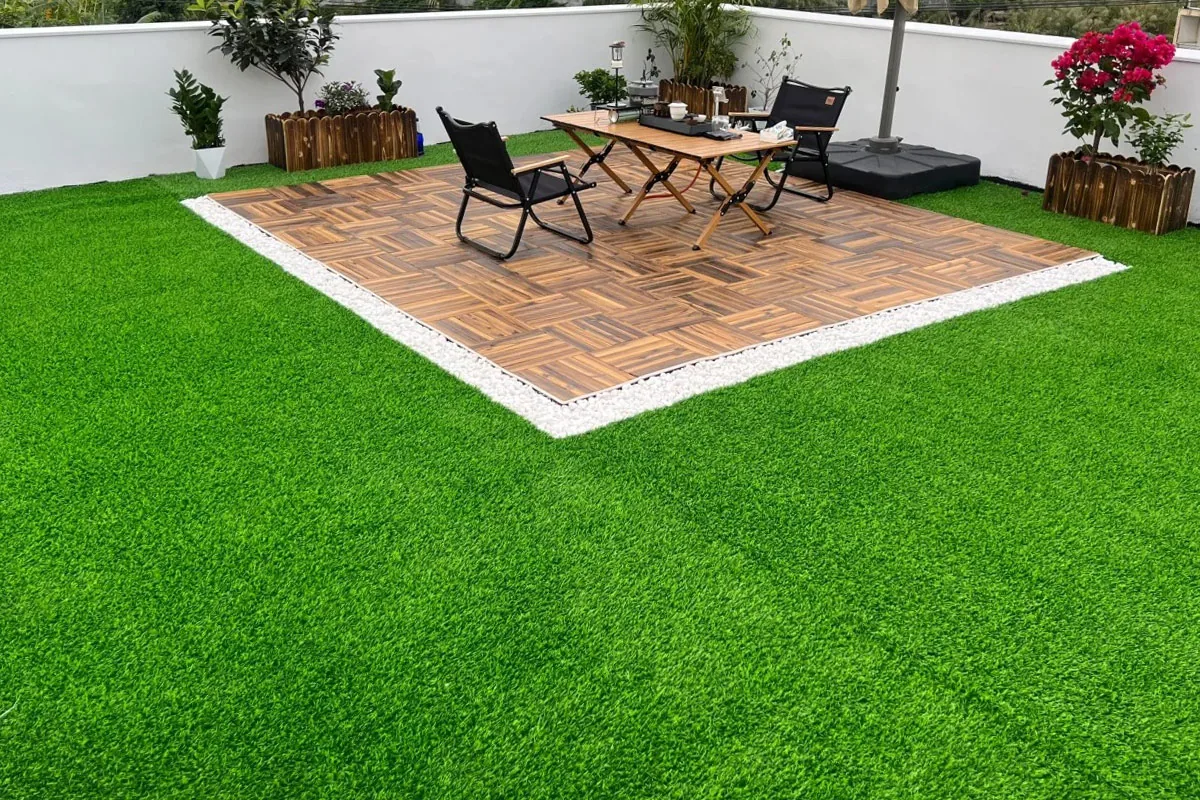
Short answer: leisure artificial grass is soft, low-pile synthetic turf made for relaxation areas rather than sport – patios, balconies, terraces, rooftops and family yards. It prioritises a comfortable foot feel and a natural look over abrasion resistance, needs no watering or mowing, and is usually specified between 25 mm and 40 mm pile height.
What leisure artificial grass is designed for
Leisure artificial grass sits between landscape turf and sports turf. It shares the general construction of synthetic lawn – polyethylene fibres tufted into a PU or SBR backing – but the yarn is softer, the pile is usually shorter, and the layout is chosen for sitting, walking barefoot and playing rather than for ball roll or studded boots. Where sports turf is engineered for shock absorption and recovery, leisure turf is engineered for touch and appearance.
That difference matters commercially. A buyer who specifies leisure grass for a penthouse terrace gets a surface that feels right underfoot and photographs beautifully, while someone who installs sports-grade turf in the same space usually ends up with a stiff, harsh finish that no guest wants to sit on.
Where leisure artificial grass works best
- Backyards and family gardens where children play and adults relax, with no mud after rain.
- Balconies and terraces on concrete, using a drainage mat instead of a stone base.
- Rooftop lounges in hotels, offices and apartment buildings.
- Courtyards and community lounges where natural grass cannot survive foot traffic and shade.
- Indoor and semi-indoor zones such as showrooms, event floors and children’s corners.
- Pool surrounds and dining decks, where a soft edge discourages slipping compared with wet stone.
Pile height and softness: how to choose
| Specification | Feel and behaviour | Typical use |
|---|---|---|
| 25-30 mm, high density | Firm, crisp, easy to clean | Balconies, rooftop decks, dining areas |
| 30-35 mm, soft yarn | Balanced cushioning and support | Family gardens, play corners |
| 35-40 mm, memory yarn | Plush, springs back after furniture | Terraces, courtyards, hospitality lounges |
| 40 mm+, low density | Very soft, can flatten under heavy use | Decorative lawns with light footfall |
Density usually matters more than pile height for a leisure surface. A dense 30 mm lawn outperforms a sparse 40 mm one both visually and in durability, because the fibres support each other instead of bending flat. Ask for face weight and stitch rate rather than judging from the pile height alone.
Leisure grass versus sports and landscape turf
| Property | Leisure grass | Sports grass | Landscape grass |
|---|---|---|---|
| Priority | Comfort and looks | Performance and shock absorption | Coverage and durability |
| Typical pile | 25-40 mm | 40-60 mm | 25-51 mm |
| Infill | None or light silica | Sand or rubber often required | None or light silica |
| Best for | Patios, balconies, terraces | Football, padel, HYROX, gyms | Gardens, parks, commercial green space |
Cost and maintenance of a leisure lawn
Leisure artificial grass costs less per square metre than a sports system because it needs no shock pad and little or no infill. The material price depends on pile height, face weight and backing; the installation price depends on the base. On soil you compact a crushed-stone layer; on concrete or a rooftop you lay a drainage mat and fix the perimeter. Either way, running costs are close to zero: no irrigation, no mowing, no fertiliser. The US EPA’s WaterSense programme for water-efficient landscaping estimates that outdoor watering can account for a large share of household water use, which is precisely what a leisure lawn removes.
- Material: pile height, Dtex and backing type.
- Base: concrete, decking or compacted aggregate.
- Edging: aluminium profile or pinned border to stop lifting.
- Roll plan: ordering full 15 ft widths cuts waste and joints.
Balcony and patio installation in six steps
- Measure the area and decide the pile direction before ordering.
- Clean the slab and check that water drains away from the building.
- Lay a drainage mat or shock pad to lift the turf off the hard surface.
- Roll out the turf and let it relax for several hours to remove creases.
- Trim to the edges, then fix the perimeter so it cannot lift in wind.
- Brush the pile upright and rinse – the lawn is ready to use immediately.
Frequently asked questions about leisure artificial grass
Is leisure artificial grass comfortable to walk on barefoot?
Yes. Leisure yarn is finer and softer than sports yarn, and a 30-35 mm dense pile gives enough cushioning for bare feet and sitting without the stiffness of a performance surface.
Will it stay flat under garden furniture?
Memory yarn and a denser stitch rate recover quickly after chairs and tables are moved. Very soft, low-density piles are the ones that flatten permanently, so check face weight if the surface will carry furniture.
Can leisure grass be used indoors?
It can, and it is common in showrooms and event spaces. Indoors the priority shifts to odour and dust control, so choose a turf with a clean backing and vacuum or rinse it regularly.
How does it hold up in strong sun and rain?
UV-stabilised fibre keeps its colour, and the perforated backing lets rain through when the base drains correctly. Fading in cheap turf comes from unstabilised polymer, not from sunlight itself.
Buying leisure artificial grass from LFL Grass
LFL Grass produces leisure and landscape turf in Yiwu, China, with roll widths up to 15 ft, PU or SBR backing and custom cut lengths for balconies and terraces that are rarely a standard size. Minimum order quantity is 500 m2 and smaller projects can ship LCL. Browse the landscape artificial grass range, compare the soft 45 mm garden turf with the lighter 25 mm lightweight turf, or send your measurements to dx@lflgrass.com for a specification and quote.
Related reading: if you are choosing turf for a whole garden, courtyard or commercial green space rather than a relaxation area, see our guide to artificial landscape grass – it compares pile heights from 25 mm to 51 mm and explains which one suits which project.
