
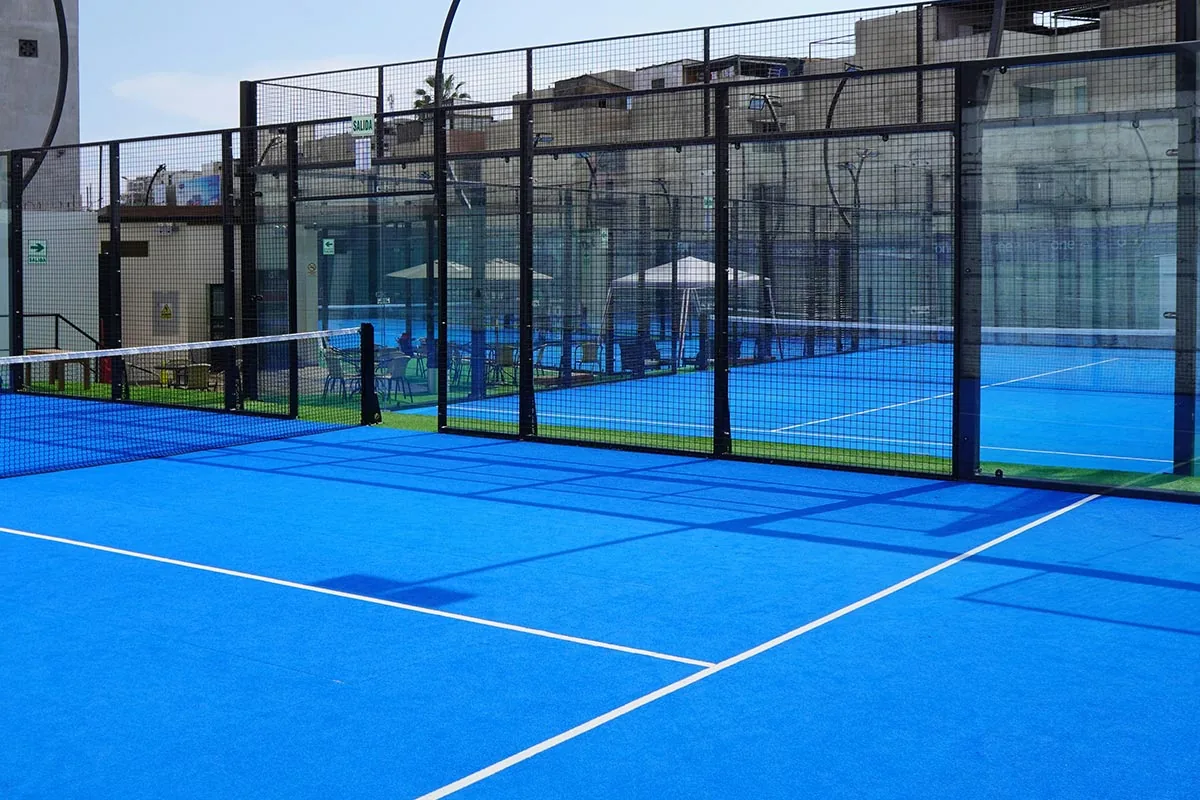
Short answer: Padel artificial grass is a short, dense synthetic carpet of 10-15 mm that is sand-dressed and installed inside a glass court. It gives consistent ball bounce, controlled slide and reliable grip in all weather, with a surface that drains fast and needs only brushing and periodic sand top-ups.
What padel artificial grass is
Padel artificial grass is not football turf cut short. It is a purpose-made textile for a game played in a glass box, where the ball must bounce predictably off a low-friction surface and players need to change direction within a few metres. The carpet is thin – typically 10 mm to 15 mm – with a dense, tightly tufted pile, silica sand dressed into the fibres, and a backing built to hold precise court dimensions without creeping at the seams.
Why padel courts use a specific surface
- Consistent bounce. Dense low pile keeps ball rebound even across the whole court.
- Slide control. Sand-dressed fibre gives predictable grip for the split step and lateral movement near the glass.
- Water management. Perforated backing plus a sloped base keeps play going after rain.
- Player comfort. Thin pile limits heat build-up while still cushioning joints compared with hard courts.
- Court identity. Colour is part of the brand: blue, green, purple and terracotta courts all read differently on camera and in broadcasts.
Pile height, yarn and sand infill
| Specification | Typical value for padel | Effect on play |
|---|---|---|
| Pile height | 10-15 mm | Lower pile plays faster; 10-15mm is the common club standard |
| Yarn type | Fibrillated or fine monofilament | Fibrillated gives a tightly knit look; monofilament resists matting |
| Sand infill | Silica sand dressed to the system specification | Weight, stability and predictable friction |
| Backing | Perforated, dimensionally stable | Drainage plus seam accuracy under tension |
| Colour | Blue, green, purple, terracotta | Court branding, contrast against lines and glass |
Club owners usually choose between a green court for a classic look and a blue or purple court for contrast against the glass and the surrounding landscape. Compare our green 15 mm padel turf with the 10-15mm blue padel court turf to see how colour changes the perception of court speed.
Court regulations and performance
Competition padel courts are dimensioned and equipped to a fixed standard, and surfacing sits inside that specification rather than alongside it: court size, line width, net height and surface friction all interact. The International Padel Federation publishes the court and competition framework that clubs and federations work from, and it is worth reading before ordering turf for a tournament venue.
Installation of a padel court surface
- Level and compact the base – asphalt or a concrete slab with a defined fall.
- Check drainage and the position of the court frame before laying any carpet.
- Roll out the turf and allow it to relax so it lies flat without tension.
- Cut and seam panels along the direction of play, then secure the joins.
- Dress silica sand evenly into the pile, working it in with a brush.
- Install lines, net and glass, then verify bounce consistency across the court.
Maintenance that keeps a padel court playable
- Weekly: brush the surface and remove loose debris.
- Monthly: check sand depth in the corners and behind the baseline; top up as needed.
- Quarterly: inspect seams and the perimeter, tighten fixings and check water drains off after rain.
- Annually: deep clean, review fibre condition, and schedule replacement planning if the court runs daily bookings.
Frequently asked questions about padel artificial grass
How long does a padel court surface last?
Club courts that take heavy bookings are typically re-surfaced every five to eight years; private courts last longer. Sand management and regular brushing are the two habits that extend that window most.
Can padel be played on artificial grass in the rain?
Light rain is playable if the base drains correctly, because the carpet is permeable. Standing water usually means the slab fall or the drains need attention rather than a problem with the turf itself.
Does the colour of padel turf affect play?
Not performance, but it changes visibility and perception. Contrast matters most between the surface, the lines and the ball, which is why blue and purple courts became popular for televised play.
Buying padel artificial grass
LFL Grass manufactures padel turf in 10-15 mm pile heights, fibrillated and monofilament yarns, custom colours and roll widths up to 15 ft, with cut lengths matched to court dimensions to keep seams on the lines. Minimum order quantity is 500 m2, with LCL shipping available for single-court projects. Start from the padel artificial grass range, compare the 15 mm fibrillated padel court turf, or send your court drawing to dx@lflgrass.com for a quotation and cut plan.
For coloured or branded courts, see the purple 15 mm padel court turf — the same 15 mm KDK specification, produced in a custom shade.
